Content Distribution vs. Influencer Marketing: What's the Difference?
Content distribution and influencer marketing can look similar from the outside, but they solve different problems. Learn the key differences and understand when each model makes sense for a brand.
Pervasive Clipping Team
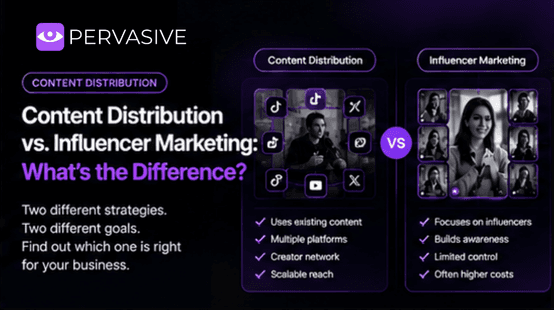
Content Distribution vs. Influencer Marketing: What's the Difference?
Content distribution and influencer marketing are often grouped together because both can involve creators.
But they are not the same strategy.
The easiest way to understand the difference is to ask:
What is the campaign trying to distribute?
Influencer marketing often distributes the creator's endorsement.
Content distribution distributes content.
At Pervasive Clipping, this distinction is fundamental to how we design short-form campaigns.
What is influencer marketing?
Influencer marketing typically involves a brand partnering with a creator who has an established audience.
The creator creates or publishes content associated with the brand.
The value comes partly from:
the creator's audience;
credibility;
personality;
relationship with followers.
The creator is an important part of the media asset.
What is content distribution?
Content distribution starts from the content itself.
For example:
A founder records a two-hour podcast.
Instead of relying only on the founder's audience, the campaign extracts short-form moments and distributes those assets through a broader network.
The core asset is the idea or content.
The creators provide distribution.
The difference in one example
Imagine a founder launches a new SaaS product.
Influencer campaign
The company pays ten influencers to talk about the product.
Each creator publishes content to their audience.
Content distribution campaign
The company records founder interviews, product discussions and educational content.
Those recordings are transformed into short-form clips.
The clips are distributed through a creator network.
Both approaches can create reach.
But the mechanism is different.
Influencer marketing is often creator-first
The question is:
Which creator should represent the brand?
Content distribution is often content-first.
The question becomes:
Which content deserves distribution, and where should it be distributed?
This changes how campaigns are built.
The role of creator audiences
In influencer marketing, audience size and audience relevance can be central.
In content distribution, creator selection can still matter, but the campaign can place more emphasis on:
publishing capacity;
content fit;
audience relevance;
platform knowledge;
performance;
consistency.
Why brands confuse the two
The platforms can look identical.
A TikTok video from an influencer and a TikTok clip distributed through a creator network may appear almost the same to a viewer.
The difference is the underlying campaign architecture.
That's why the distinction is strategic rather than visual.
Which model should a company use?
It depends on the objective.
Influencer marketing may make sense when the objective is:
creator endorsement;
product placement;
accessing a specific creator audience;
association with a creator's personal brand.
Content distribution may make sense when the objective is:
maximizing the reach of existing content;
increasing short-form publishing volume;
distributing founder expertise;
creating multiple discovery opportunities;
building a repeatable content engine.
Some businesses may use both.
The hybrid model
There is no requirement to choose only one.
A brand could:
produce long-form content;
clip it;
distribute the clips through a creator network;
partner with selected influencers for dedicated campaigns.
This creates multiple distribution layers.
What Pervasive Clipping focuses on
Our focus is the content distribution side.
We help businesses turn the content they already produce into short-form assets and build the systems required to distribute them.
That means:
Content → Clips → Creators → Distribution → Data
The creator is important.
But the creator isn't necessarily the product.
The distribution system is.
The question to ask
Before deciding between these strategies, ask:
“Do I need creators to promote my brand, or do I need creators to distribute my content?”
That single distinction can clarify the campaign considerably.
If your company already produces valuable long-form content, the second problem may be more relevant than you think.
Final takeaway
Influencer marketing and content distribution can overlap, but they are built around different mechanisms.
Influencer marketing often leverages the creator's audience and endorsement.
Content distribution uses creators as part of a broader system for distributing content.
At Pervasive Clipping, we specialize in the second problem.
If you already have podcasts, interviews, YouTube content, founder videos or other long-form assets, book a call with us.
We'll help you determine whether your biggest opportunity is creating more content, finding more creators, or simply building a better distribution system around what you already have.
