What Is a Clipping Campaign?
A content distribution campaign turns existing content into a repeatable system for generating reach across social platforms. Here is how strategy, content selection, creators, publishing and performance measurement work together.
Pervasive Clipping Team
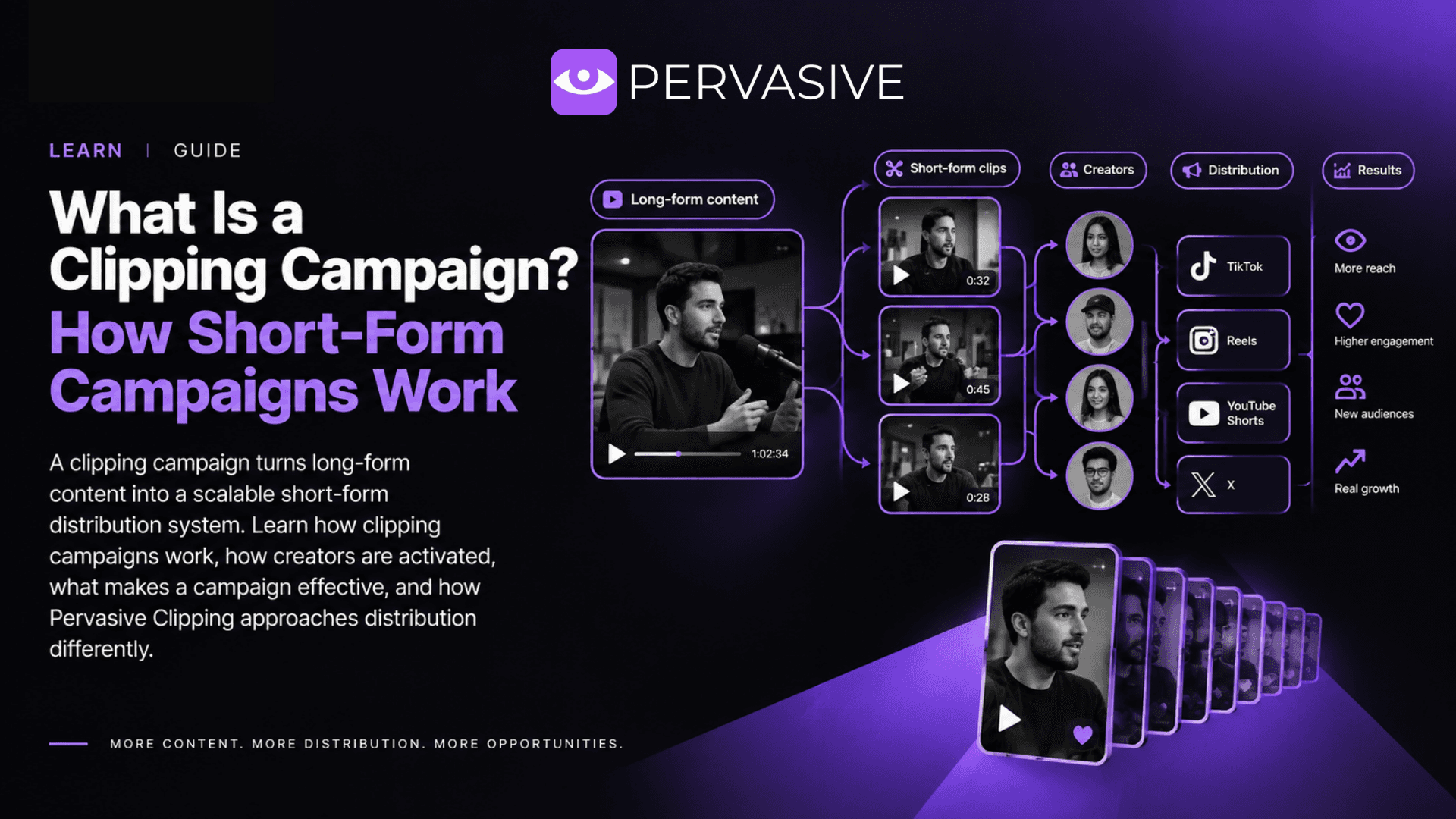
How Does a Content Distribution Campaign Work?
Creating content and distributing content are two different problems.
A company can spend thousands of dollars producing a podcast, interview or YouTube video and still reach only a fraction of the audience that content could potentially generate.
A content distribution campaign is designed to solve that problem.
At Pervasive Clipping, we think about distribution as a system:
Source Content → Short-Form Assets → Distribution → Measurement → Optimization
The purpose isn't simply to publish more.
It is to create more opportunities for the right people to discover the content.
What is a content distribution campaign?
A content distribution campaign is a structured process for taking existing content and distributing it through multiple channels, formats or creators.
For short-form campaigns, that usually means transforming long-form content into videos suitable for platforms such as:
TikTok;
Instagram Reels;
YouTube Shorts;
X and other social channels.
The key difference between ordinary social posting and a distribution campaign is the system behind the publishing.
Instead of asking:
“What should we post today?”
you ask:
“How can this content generate the maximum number of relevant distribution opportunities?”
That change in thinking is important.
Step 1: Start with the source content
A distribution campaign should begin with the content that already exists.
For example:
a podcast episode;
a founder interview;
a webinar;
a YouTube video;
a keynote;
a livestream.
The first task is to identify the ideas that can survive outside the original piece of content.
This is not always the same as selecting the most interesting moment.
A good short-form segment needs context, a clear idea and a reason for someone unfamiliar with the original video to keep watching.
Step 2: Build the content library
Once the source material has been analyzed, the next step is creating a library of potential clips.
This gives the campaign something extremely valuable:
consistency.
Instead of producing one clip whenever the team has time, you create a structured pipeline.
The pipeline can look like:
Long-form recording → Analysis → Clip selection → Editing → Approval → Distribution
This allows distribution to become repeatable.
Step 3: Define the distribution strategy
Not every clip needs to be distributed in exactly the same way.
A campaign might prioritize:
volume;
specific audiences;
specific platforms;
specific themes;
specific creators;
specific business objectives.
For example, an educational SaaS company might want its clips to emphasize product education, founder expertise and industry insights.
A personal brand might prioritize opinions, stories and authority.
A podcast might prioritize controversial conversations and highly shareable moments.
The distribution strategy should reflect the underlying business.
Step 4: Activate creators
This is where a distribution campaign can become significantly more scalable.
Rather than relying exclusively on the brand's own accounts, content can be distributed through a network of creators.
Creators provide additional publishing surfaces and audience contexts.
But there is an important distinction:
A creator network is not simply a list of accounts.
The campaign needs a system for:
onboarding creators;
communicating the brief;
distributing assets;
monitoring publishing;
measuring results;
identifying strong performers.
This operational layer is one of the reasons companies work with specialized clipping agencies.
Step 5: Measure what happens
A campaign without measurement is difficult to improve.
At minimum, you should understand:
views;
reach;
engagement;
publishing volume;
performance by clip;
performance by creator;
performance by platform.
But raw views should not be the only consideration.
A million views from an irrelevant audience may be less useful than a smaller amount of highly relevant attention.
The right metrics depend on the campaign objective.
Step 6: Optimize the campaign
This is where experience becomes valuable.
Suppose the first 50 clips show that:
educational clips consistently outperform generic statements;
videos with stronger openings retain viewers longer;
certain creators consistently outperform others;
specific topics generate more engagement.
The next campaign iteration should reflect that information.
The goal is not to repeat the same process forever.
It is to create a feedback loop.
Why companies struggle with content distribution
The problem usually isn't a lack of content.
It is operational complexity.
Someone has to:
find the moments;
brief editors;
review videos;
organize assets;
coordinate creators;
monitor publishing;
collect data;
make decisions.
For a founder or marketing team, this quickly becomes another full-time workflow.
This is where an agency can provide leverage.
How Pervasive Clipping approaches distribution
At Pervasive Clipping, we don't see ourselves as an editing vendor.
The objective is to build a distribution system around your existing content.
That means thinking about the entire chain rather than optimizing one isolated step.
We care about:
what gets clipped, why it gets clipped, where it gets distributed, who distributes it and what the data says afterward.
That approach is particularly useful for businesses that already have strong long-form content but aren't extracting enough reach from it.
What a campaign can look like
Imagine a company publishes four long-form videos per month.
Instead of treating each video as a single social asset, the company can create a short-form distribution pipeline around the content.
Each recording becomes a source for multiple potential clips.
Those clips can then be distributed across the campaign's selected channels and creators.
The result is not simply “more posts.”
It is a larger distribution footprint built from the same original content.
When should you build a distribution campaign?
You should consider it when:
you already create valuable content;
your team struggles to distribute it consistently;
your content gets little reach relative to its production cost;
you want to increase short-form output;
you want to experiment with creator-led distribution;
you want a repeatable system rather than occasional viral posts.
If none of these apply, simply creating more content may be premature.
But if the content already exists, distribution is often the next logical layer.
The strategic question
The most important question isn't:
“How many clips can we make?”
It is:
“How much distribution potential exists inside the content we're already producing?”
That's the question we help clients answer at Pervasive Clipping.
If you'd like to see what that looks like for your content, book a call with our team.
We can assess your existing content pipeline and show you where short-form distribution could fit.
