What Is a Clipping Campaign? How Short-Form Campaigns Work
A clipping campaign turns long-form content into a scalable short-form distribution system. Learn how clipping campaigns work, how creators are activated, what makes a campaign effective, and how Pervasive Clipping approaches distribution differently.
Pervasive Clipping Team
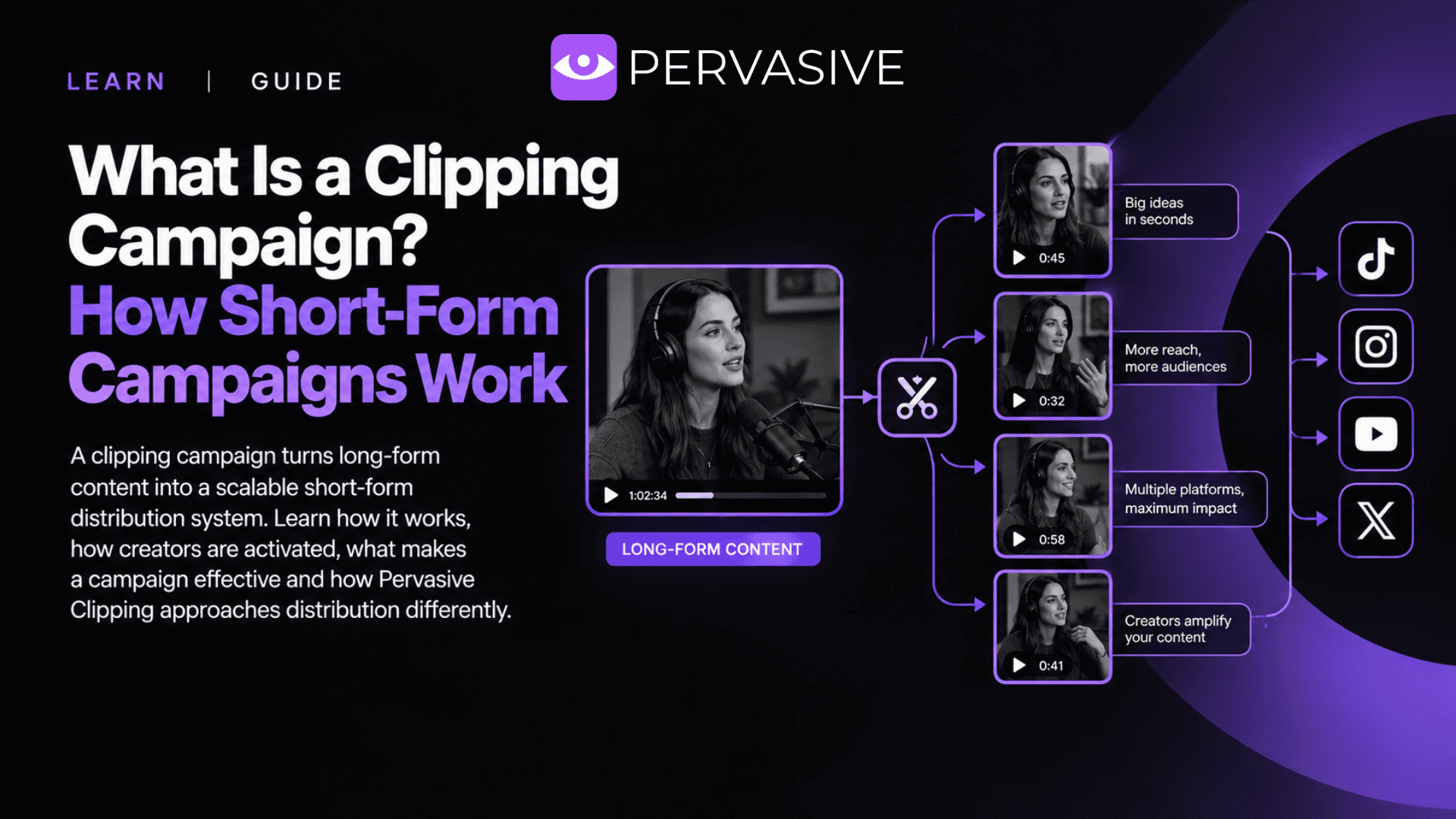
What Is a Clipping Campaign? How Short-Form Campaigns Work
A clipping campaign is a structured system for turning long-form content into a large volume of short-form videos and distributing those videos across social platforms.
Instead of publishing one video and hoping it reaches the right audience, a clipping campaign creates multiple opportunities for discovery from the same underlying content.
At Pervasive Clipping, we look at clipping differently.
Clipping is not simply cutting a podcast into smaller videos.
It is a content distribution strategy.
The difference matters.
If the objective is only to create clips, the process usually ends when the video is exported.
If the objective is distribution, the real work starts after the clip is created.
How a clipping campaign works
A professional clipping campaign generally has five stages:
Content analysis
Clip production
Creator distribution
Performance tracking
Optimization
The first stage is often underestimated.
A 60-minute podcast might contain dozens of potentially useful moments, but not every moment deserves to become a short-form video.
A strong campaign starts by identifying moments that can work independently.
These might include:
controversial opinions;
useful insights;
surprising stories;
strong statements;
educational explanations;
emotional moments;
predictions;
mistakes and lessons;
highly specific advice.
The goal is not to summarize the original video.
The goal is to identify moments that can generate attention on their own.
Clipping is not the same as repurposing
Repurposing usually focuses on adapting an existing piece of content into different formats.
Clipping can be part of that process, but a clipping campaign goes further.
The important question becomes:
How can this piece of content generate as many qualified discovery opportunities as possible?
For example, imagine a founder records a two-hour podcast.
A traditional content workflow might produce:
one podcast episode;
three social posts;
perhaps five short clips.
A distribution-focused workflow might analyze the same recording for dozens of potential moments and then distribute selected clips through a creator network.
The underlying content has not changed.
The distribution system has.
Why distribution matters more than simply producing clips
One of the biggest mistakes we see is treating editing as the end product.
It isn't.
A beautifully edited clip that nobody sees has limited business value.
This is why Pervasive Clipping focuses on the entire system:
Content → Clips → Creators → Distribution → Data → Optimization
Each step affects the next.
If the content selection is weak, better editing will not solve the problem.
If the clips are good but distribution is limited, reach remains limited.
If distribution is strong but performance isn't measured, there is no reliable feedback loop.
A campaign becomes powerful when these components work together.
The creator network
A clipping campaign can use an internal publishing team, a creator network, or a combination of both.
Creator distribution is particularly useful when the objective is to create a larger number of independent distribution points.
Instead of relying entirely on one brand account, content can be distributed through multiple creators and accounts.
This creates more opportunities for the content to enter different audience ecosystems.
However, simply having a lot of creators isn't enough.
Creator selection matters.
The creators need to understand:
what type of content performs;
how the campaign should be positioned;
which moments to prioritize;
how to publish correctly;
what metrics matter.
That is why campaign management is important.
What makes a clipping campaign successful?
There isn't one magic clip format.
Instead, successful campaigns usually have a strong combination of:
1. Strong source content
If the original content contains no interesting ideas, clipping cannot manufacture them.
The best campaigns start with content that already contains expertise, stories, opinions or useful information.
2. Good clip selection
The most valuable moment in a one-hour recording isn't necessarily the funniest moment.
It may be the sentence that makes someone stop scrolling.
3. Strong hooks
The first seconds matter because short-form content competes directly with everything else in the feed.
A clip needs a reason to continue watching.
4. Distribution volume
A single clip creates one opportunity.
Multiple relevant clips create many.
5. Feedback
Performance data should influence what gets produced and distributed next.
This is where a campaign becomes a system rather than a batch of edits.
How many clips should a campaign produce?
There is no universal number.
The correct volume depends on:
how much source content exists;
how frequently new content is produced;
the campaign objective;
the creator network;
available budget;
platform strategy;
performance.
A podcast recorded once per week could potentially generate a large library of short-form opportunities.
But publishing more content simply for the sake of volume is not the goal.
The goal is to create more qualified opportunities for discovery.
When should a business consider a clipping campaign?
Clipping becomes particularly interesting when you already have valuable long-form content.
That could include:
podcasts;
interviews;
webinars;
YouTube videos;
educational content;
founder conversations;
livestreams;
conference talks.
If you are already investing time and money into producing this content, the next question should be:
Are we extracting enough distribution from it?
At Pervasive Clipping, this is exactly the problem we help businesses solve.
We don't approach clipping as “send us a video and we'll edit it.”
We build the distribution layer around the content.
The Pervasive Clipping approach
Our approach starts with the source material and works backwards from the desired distribution outcome.
We look at:
what the content is actually saying;
which ideas have the strongest short-form potential;
which formats fit the campaign;
where distribution should happen;
how creators should be activated;
what performance should be tracked.
That means the campaign is designed around distribution, not editing alone.
Final takeaway
A clipping campaign is a way to turn existing long-form content into a repeatable short-form distribution engine.
The most important distinction is simple:
Clipping creates assets. Distribution creates opportunities.
If your business already produces podcasts, interviews, YouTube videos or other long-form content, the question isn't necessarily whether you need more content.
You may need to get more distribution from the content you already have.
If you want to understand what that could look like for your own content library, book a call with Pervasive Clipping.
We'll look at your existing content, identify the distribution opportunities and explain what a realistic clipping campaign could look like.
